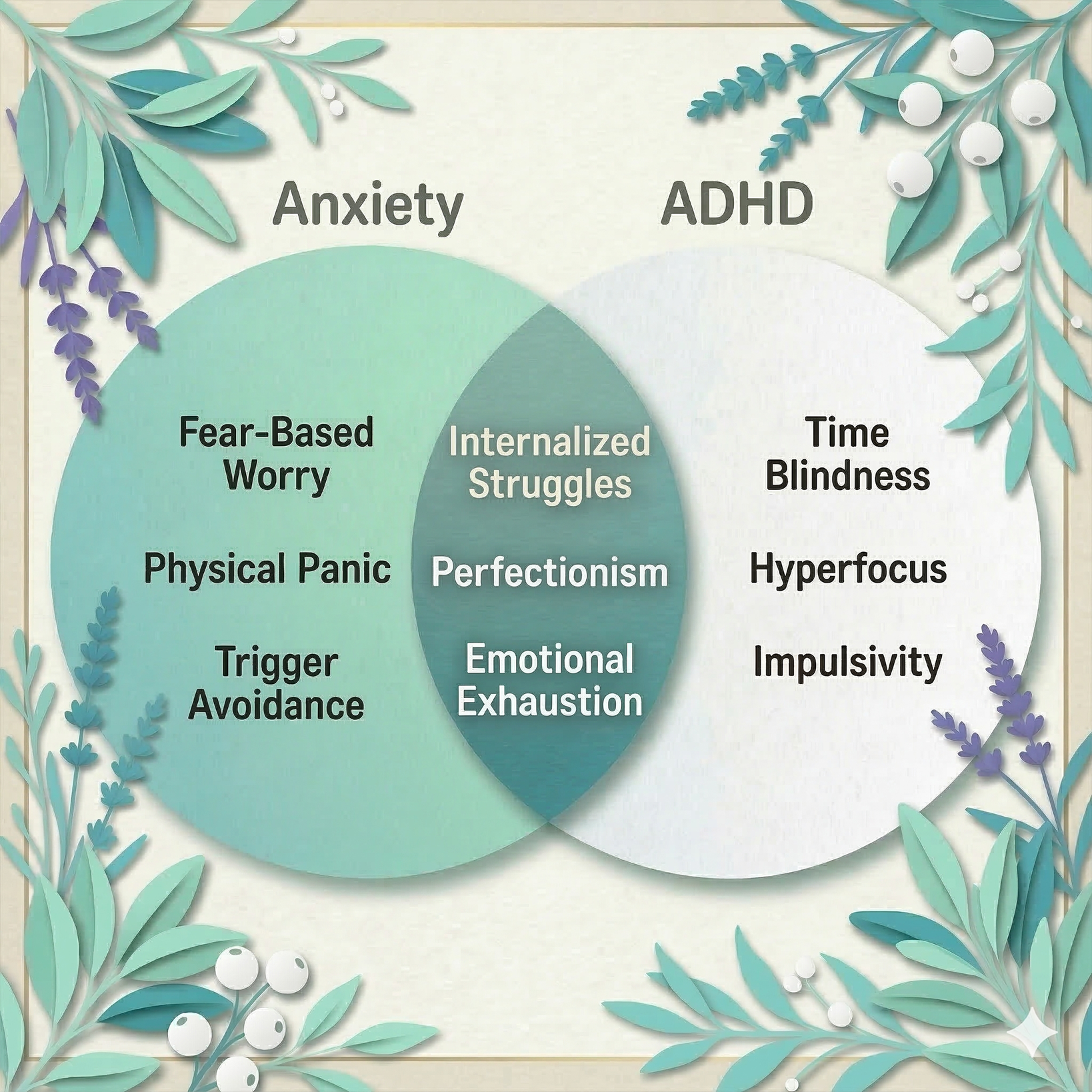
Anxiety vs. ADHD: How to Tell the Difference
A lot of adults start therapy with the same quiet question in the back of their mind: Why does everything feel so hard when it looks like I should be fine?
You might notice you can’t focus the way you want to. Tasks pile up even when you care about them. Your thoughts feel busy or scattered. You’re stressed, reactive, exhausted — and unsure whether you’re dealing with anxiety, ADHD, or something else entirely.
Maybe you’ve asked yourself:
- “Is this just anxiety?”
- “Do I actually have ADHD?”
- “Why do I relate to both?”
This uncertainty is incredibly common — especially for adults who learned early on how to push through, mask struggles, or hold themselves to high expectations.
So, why are anxiety and ADHD often confused?
On the surface, anxiety and ADHD can look almost identical.
Both can show up as:
- Trouble focusing
- Racing thoughts
- Procrastination
- Restlessness
- Emotional overwhelm
- Irritability or frustration
So it makes sense that many adults feel confused, or worry they’re “missing something.” It’s not that you’re bad at self-reflection. It’s that these two experiences overlap more than people realize.
The real difference usually isn’t what you’re experiencing, it’s what’s driving it underneath.
When It’s Anxiety
Anxiety is often about threat, even when the threat isn’t obvious.
Your mind may be scanning for what could go wrong. Your body stays on high alert. You might feel tense, over-prepared, or unable to relax, even when things are objectively okay.
Anxiety in adults often sounds like:
- “I can’t stop thinking.”
- “If I don’t stay on top of everything, something bad will happen.”
- “I need to get this right.”
When anxiety affects focus, it’s usually because your attention keeps getting pulled toward worry, anticipation, or fear-based thinking. Your brain is trying to protect you — even if it’s working overtime.
When It’s ADHD
ADHD tends to be less about fear and more about regulation.
Your brain may struggle to stay engaged unless something feels interesting, urgent, or stimulating. You might care deeply about something and still feel unable to start or finish it.
Adult ADHD often sounds like:
- “I want to do this, but I can’t get myself moving.”
- “I lose track of time without realizing it.”
- “I feel restless or bored even when I don’t want to be.”
Focus issues in ADHD aren’t about not trying hard enough — they’re about how attention and motivation are wired.
A helpful question to ask yourself to explore the difference is to ask:
Am I avoiding this because I’m afraid? Or because I can’t get my brain to engage?
- If fear, worry, or perfectionism are front and center, anxiety may be playing a larger role. - If activation, boredom, or time-blindness are the main barriers, ADHD may be contributing more.
That said, it’s not always one or the other.
When It’s Both
Many adults live with both anxiety and ADHD, often without realizing it.
Sometimes ADHD comes first, and anxiety develops after years of feeling behind, criticized, or overwhelmed. Other times anxiety is primary and makes focus and organization much harder.
This is why online quizzes often feel unsatisfying. They don’t capture the full picture of how your nervous system, history, and environment interact.
So many adults don’t get answers until later.
A lot of adults, especially women and high-achieving individuals, weren’t flagged earlier because:
- They internalized struggles instead of acting out
- They performed well academically or professionally
- Perfectionism helped them cope (until it didn’t)
- Emotional exhaustion was labeled as “stress” or “burnout”
By the time they seek help, they’re often tired, self-critical, and wondering why things feel harder for them than for everyone else.
So, how does therapy help make sense of all of it?
Therapy isn’t about rushing to a diagnosis or putting you in a box. It’s about slowing down and looking at patterns:
- How long have these struggles been there?
- What situations make them worse or better?
- How does your body respond to stress?
- What have you been carrying without realizing it?
Instead of asking, “What label fits?” therapy asks, “What’s actually happening and what kind of support would help?”
That understanding is what guides treatment, whether anxiety, ADHD, or both are involved. And that’s why clarity matters.
When you understand what’s driving your symptoms, support becomes more targeted — and more effective.
Anxiety-focused work often centers on calming the nervous system and loosening fear-based patterns. ADHD-focused work tends to emphasize executive functioning support, emotional regulation, and reducing shame.
When both are present, an integrated approach can be incredibly relieving.
If you’re still unsure, that's OKAY.
Most people don’t start therapy with clear answers. They start because something feels off, heavier, louder, or more exhausting than it should.
You don’t need to figure this out on your own. Therapy can be the place where clarity develops, gradually and collaboratively.
Taking the Next Step
If you’re wondering whether anxiety, ADHD, or both might be influencing your experience, talking with a mental health professional can help you sort through it — without pressure to label yourself.
A consultation gives you space to:
- Talk through what you’re noticing
- Ask questions
- Explore possible next steps
- Decide what kind of support feels right
To learn more or schedule a consultation, you can contact our Clinical Account Specialist:
Emily Whitman
862-330-1727, extension 3
Reaching out doesn’t mean committing to anything. It simply opens a door to understanding yourself a little more clearly, and deciding what support might help next.
